Wednesday, July 4, 2018

Impressionism and Cinema for the World War I Preparedness Movement


                   Childe Hassam,The Fourth of July, 1916 (The Greatest Display of the
                   American Flag Ever Seen  in New York,  Climax of the Preparedness 
                   Parade in May), 1917, New-York Historical Society.  


After War broke out in Europe in 1914, the American Impressionist Childe Hassam started in 1916 a Flag Series of about thirty works to encourage American to support the Preparedness Movement. Wilson the moralist wanted the United States to remain neutral so he would be in a stronger position to broker a compromise peace in Europe. Teddy Roosevelt, the carry a big stick practitioner of the realpolitik school was at the forefront of preparedness. Other famous proponents of preparedness were General Leonard Wood, Henry Stimson who was Secretary of War under President Taft, Admiral Dewey, and Elihu Root, Secretary of War under McKinley and Roosevelt. Neutrality was supported by immigrants from Scandinavia, Ireland, and Germany. Left wing socialists saw the war as an ideological  corupt  conflict between German militarism and British imperialism. Industrialists were divided. There was a strong pacifist movement in the rural protestant heartland of America.The Yiddish newspapers were initially pro German because of the pogroms and antisemitism in the Russian Empire. Irish American Catholics, were anti British, especially after the Easter Uprising of 1916 in Ireland to end British rule. Women and especially suffragists were strongly isolationists.

In 1914, the U.S. Army was about 100,000 and the National Guard wasn't much larger. The German army had about 4 1/2 million on active duty and in the reserves. The Preparedness Movement  organized the Military Training Camps Association, where volunteer college graduates would receive officer training without any enlistment obligation. The summer camp in Plattsburgh NY was the most well known. Like most private summer camps it was attended by well to do elitists who didn't have to rely on a job to survive.


The Preparedness Movement gathered more momentum after the sinking of the British ocean liner Lusitania sailing from NY to Liverpool by a German U-boat off the coast of Ireland in May 1915. 128 U.S citizens died.

In September 1915, the silent film The Battle Cry of Peace was released. There were scenes of a foreign Army invading New York City. Bombs dropped on crowds in Times Square. The artillery from the coastal batteries falls short of an advancing fleet. Admiral Dewey, General Wood, and Secretary of War Lindley Garrison appear in the film to lend authenticity to what will happen if America is not prepared for war. The film received almost as much press and criticism as Birth of a Nation, released earlier that year. Henry Ford placed an article "Humanity and Sanity" in more than 250 newspapers alleging that munitions manufacturers had inspired the film. Vitagraph sued Ford for a million dollars.


Many viewers did not consider the invasion and slaughter of New Yorkers to be an impossible fantasy. Neutral Belgian, at the beginning of the war had been invaded by Germany during their advance to Paris. Germany considered Belgium civilians as dangerous as the small Belgium army and about 25,000 civilians died during executions, deportations, imprisonment, or being mistaken for snipers. There was widespread looting and burning of homes and public buildings. Louis Raemaekers, a Dutch newspaper cartoonist, went to Belgium to record the atrocities and convince neutral Netherlands that they needed to join the Allies. His cartoons also appeared in American newspapers. Later in the war the phrase Rape of Belgium, would be a propaganda slogan to promote the sale of War Bonds.

        Louis Raemaekers, The Hostages. The execution of the 
        Mayor of Aerschot, Belgium, together with his son and brother, 

        by the invading Germans, 20 August 1914.


Disagreeing with Wilson over Preparedness, was detrimental to a career. General Leonard Wood had been appointed Army Chief of Staff by President Taft in 1910. He returned to a command position after Wilson didn't reappoint him in 1914. Wood ran into more conflict with Wilson because he had authorized a regiment of Marines to be used as extras in the film Battle Cry of Peace. Wilson appointed John J. "Black Jack" Pershing to be Commander of the American Expeditionary Force and Wood was given a non-combat position training two divisions. Secretary of War Lindley Garrison conflicts with Wilson intensified after he wanted Wilson to intervene in the Mexican Revolution to restore order. Their conflict worsened over Wilson's neutrality about the War in Europe, and Garrison resigned in 1916. Assistant Secretary of War Henry Breckinridge also resigned out of loyalty to Garrison. Former Secretary of War Henry Stimson was selected by Teddy Roosevelt to be one of the officers to raise a volunteer unit. Wilson refused to use the unit. Stimson served in the regular army as an artillery officerAdmiral Dewey was too old and removed from politics to suffer from Wilson's vindictive personality. 

The July 4, 1916 Preparedness Parade in New York City had over 100,000 marchers and lasted for over 12 hours. Hassam's flag paintings also included scenes of Fifth avenue without parades.


Childe Hassam, Flags on the Waldorf, 1916
1916, Amon Carter Museum of American 
Art, Fort Worth, Texas

Childe Hassam, Rainy Day, Fifth Avenue,1916,1916,
Princeton University Art Museum, Princeton, NJ 
  

Childe Hassam, The Avenue in the Rain 1917, 1916. 
The White House
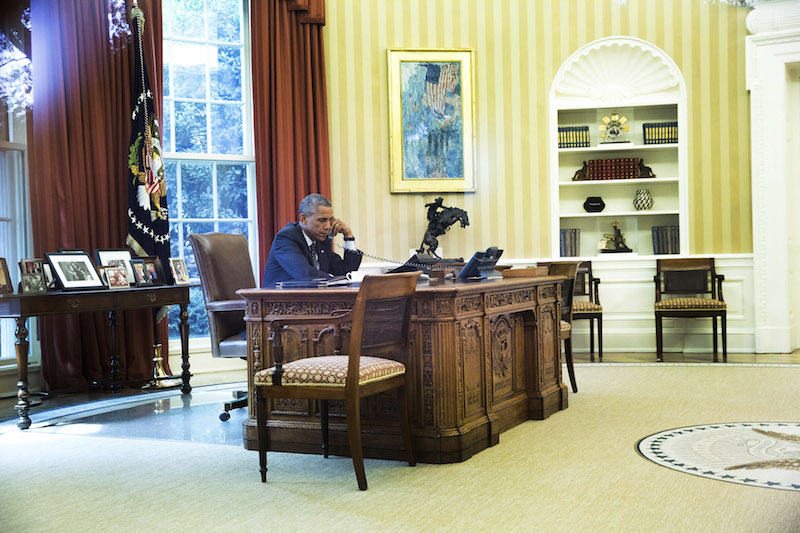
The Avenue in the Rain 1917 was exhibited several times in 1916. The discrepancy in dates is probably because an incorrect label remains on the canvas stretcher.The Avenue in the Rain, 1917 is  now part of the White House permanent collection. Clinton and Obama displayed the painting in the Oval Office.

Oval Office during the Clinton Administration

Oval Office during the Obama years. 

President Trump had the painting replaced with a portrait of Andrew Jackson, the President who signed the Indian Removal Act of 1830. Unsettled lands west of the Mississippi were exchanged for Indian lands within existing state borders. A few tribes went peacefully, but most resisted the relocation policy. Cherokees were forcibly moved west and approximately 4,000 died on this forced march, now known as the "Trail of Tears."


Trump invited Navajo Code Talkers to the White House for recognition of their service during the Second World War. It was at this ceremony by the portrait of Jackson, that Trump referred to Senator Elizabeth Warren as Pocahontas.

Two events in 1917 made it impossible for Wilson to continue to remain neutral. In January, a secret diplomatic communication from the German Foreign Office to the German Ambassador in Mexico proposed a military alliance between Germany and Mexico in exchange for Texas, Arizona, and New Mexico. Americans were furious especially since Pancho Villa had launched a raid into the town of Columbus, New Mexico the year previously.

On February 1, 1917 the German Government announced it would again conduct unrestricted submarine warfare. Five American ships were sunk by German U-boats during the next two months.

A month after the United States entered the War, New York displayed French, British, and American Flags to welcome British and French War Commisioners


Allies Day, May 1917, 1917, National Gallery of Art, Washington, D.C.


On the west (left) side of Fifth Avenue is the St. Thomas Church, completed three years earlier in a Gothic Revival style. Beyond it is the University Club in a Renaissance Revival style. Next is the Gotham Hotel in neoclassical style. The last building visible is the Fifth Avenue Presbyterian Church. The large flags are pointing to the buildings that were frequented by the elite of the city. Preparedness Parades were to convince the elite of the Government and didn't go through crime infested slums. A subtle message is that we use similar architectural language and shouldn't be Isolationist. The flags pointing to the bright illuminated churches in the sunlight implies which side God favors.


Avenue of the Allies: Great Britain, 1918


In 1918, Fifth Avenue between 33rd and 59th Streets would become known as Avenue of the Allies . For the fourth Liberty Loan Drive Parade each of the Allies had a section of the avenue for their flags. In the above painting, The flags of Great Britain and Canada are from 53rd Street to 54th Streets. Brazil is at 55th Street and Belgium is at 56th Street. 


Avenue of the Allies: France, 1918. 1918


Looking North, the Greek Flag is at 45th Street. The flags of the newly created Czecho-Slovakia are between 47th and 48th streets Street. French Flags are in the foreground. Hassam compressed distance in his Flag Series to make the flags appear closer together.    


The above photograph taken of the fourth Liberty Loan Drive Parade without a telephoto lens demonstrates the realistic width of the avenue and placement of the flags.


Childe Hassam flag series paintings are similar to Monet's flag paintings of 1878.
Claude Monet, The Rue Montorgueil in Paris. Celebration of June 30, 1878
Claude Monet, The Rue Saint-Denis, Celebration of June 30th 1878


June 30, 1878 was the first official national celebration following the defeat of Napoleon III in 1870, when the conservatives regained power. Two years later, in 1880, July 14 was designated the French National Day.

When French Impressionism is compared to American Impressionism some authors will comment that the brush strokes in French Impressionism are looser and shorter and that there is more abstraction and blurring with a sense of motion. True, there is more naturalism to the buildings in Allies Day, May 1917, but the people on the street in The Avenue in the Rain are abstracted. The French with some exceptions  abandoned Impressionism and embraced the avante-garde and the rapid succession of "isms" of the 20 th Century. Impressionism had a much longer run in the United States, especially in the Art Colonies along the California coast through the twentieth Century . There were too many individualistic styles of American Impressionism to make such comparisons meaningful.

Thursday, April 26, 2018

Impressionism In Socialist Realism in the USSR

It was the only State approved art style in the Soviet Union after 1932. Many of the paintings were homages to the communist leaders. Other works lacked any artistic merit or were outright lies such as Arkady Plastov's pictorial myth of happy peasants celebrating under a portrait of Stalin in Collective Farm Festival.

Arkady Plastov, Collective Farm Festival, 1937.
Collectivization caused famines in 1932–33 that killed about 5 million ethnic Ukrainians. Over three million kulak (land owning) farmers were arrested, executed or deported. The banner reads Life has become better. Life has become more cheerful  – a frequently quoted line from a Stalin speech.

Yuri   Kugach, Glory to the Great Stalin, 1950
Glory to the Great Stalin, perpetuates the Cult of Stalin. With the Cold War underway, non-Communists in the West, did not think Socialist Realism was a legitimate style. It persisted in an attenuated form during the 1970's, was essentially non-existent during the Perestroika years, and officially ended with the dissolution of the Soviet Union in 1991.

However, there is a plethora of works where artists were able to demonstrate their individual creative skills and still satisfy the State doctrine of promoting the achievements of the Socialist State. Stalin had never said how Socialist Realism should look. He focused on the content and promoting the achievements of his collective utopia. The highly individualistic Avant-garde styles were eliminated during the first 15 years after the 1917 Revolution. The content needed to be accessible to the peasants, factory workers and intelligentsia. Impressionism was frequently used as a stylistic vehicle for Socialist Realism.


Gleb Barabanshchikov, Picking Flowers, 1945
Picking Flowers, could be French Impressionism of the 1870's in the bright fields in the South of France. The girl, however has a red neckerchief of the Young Pioneers, a youth organization in the Soviet Union for children from age 9 to 15. The other children in the background also have neckerchiefs and there is a red banner at the gate. It is a summer camp for Pioneers. The Pioneer movement was instrumental in eliminating illiteracy after the Revolution. Unlike going to a Scouting Jamboree in capitalist countries, the children do not pay any expenses or sell cookies. After finishing the Young Pioneers, children with a recommendation could join Komsomol, the Young Communist League. When I travelled in Socialist countries during the early 1980's I enjoyed taking pictures of the Pioneers. They were friendly, smiled, and never asked for money like children did in Third World countries.

Portraits needed to show healthy, physically strong individuals with superior moral qualities. The concept of tipichinost (typicality) was paramount in portraits.  In the 1950's I had the notion that citizens in the Soviet Union were like robots who waited in long lines to get a shirt that the government handed them. Whether the person liked the color of the shirt or not was not important. Tipichinost did not mean that the portraits eliminated the individual personality from the portrait. An athlete, soldier or rural peasant each had their own tipichinost that could be understood by the viewer.

In Alexander Samokhvalov series of portraits of the New Soviet Woman, the individual traits are evident.
A. N. Samokhvalov, Girl with a Shot Put, 1932.
In Girl with a Shot Put, the bright sunlight emphasizes the feminine features of her breasts, groin and short hair sensuously covering part of her face. The shadows emphasize her muscular strength. The blue letter D on her shirt is the logo for the Dynamo Sports Club, the largest Soviet sports club with it's headquarters in Moscow and affiliate clubs world wide. In Russian the word dynamo has the connotation of power in motion and also can mean a power generator. The color red, symbol of the power of the Soviet Union and Red Army is the color of her skimpy clingy briefs.

A. N. Samokhvalov, Girl in a Football Jersey, 1932.
Girl in a Football Jersey was awarded a gold medal at the the 1937 Paris International Exposition.  Pablo Picasso’s Guernica was entered that year but didn't win an award.

Alexander Samokhvalov, Girl in an Interior, 1940
The young woman in her comfortable apartment with a piano is part of the intelligentsia. She also is the builder of the Soviet future. Impressionism with soft edges and muted colors creates a dream like intimate  environment. Flowers, tea, wine, a lemon, nice drapery, a large dog and a small piano almost touching the dining table, signify a comfortable but not excessive way of life.

Grigori Pavel, Crane Operator, Крановщица, 1955.

The young woman in Crane Operator, is not afraid to work on the dangerously open platform. She is painted from a low angle and looms over the viewer from high in the sky. The red kerchief shows her allegiance to Socialist State. The Soviet Union prided itself that it didn't have gender discrimination. More than a half century after this painting was made, minority and female crane operators are still underrepresented in the construction trades in the Unites States. The buildings and cranes in the background show the post war housing boom that was occurring in the Soviet Union.

Yuri Pimenov, New Moscow, 1937.
If 19th Century French Impressionism could make the new widened boulevards and fashionably dressed pedestrians of Paris look so appealing, it could do the same for Moscow, but with an ideological slant. In New Moscow, a young woman in a stylish dress and a modern short hair style is driving a convertible. She is liberated and unescorted. The red carnation signifies she supports the Socialist state. Stalin began his General Reconstruction of Moscow in 1934, during the Second Five Year Plan that focused on urbanization and social services. Old narrow pre-Revolutionary streets were torn down. The new Stalinesque tall buildings are in the background. She is driving from the past with the classical and neoclassical architecture to the Socialist future. To the right of the second lamp post is a white M that marks the entrance to the Moscow Metro. In 1935 the first line of the Metro opened. Over a quarter million people rode the Metro during the opening day celebrations. It was one of the great achievements of the new Socialist state. The New York subway averaged only 25 mph but the Moscow Metro averaged 47mph. Without developing the steel industry during the First Five Year Plan (1928–1932), there wouldn't have been enough steel to build the Metro. After the War, Stalin wanted skyscrapers. He had seven of the ugliest ornate Ghostbuster type wedding cake buildings constructed, while other major cities were using the International Style.


Fedot Sychov painted Russian and non-Russian citizens in the villages of the Volga Federal District. The paintings look similar but not the people. Mordvinians continued to wear national clothing but through Socialism, the females are now literate.

           Fedot Sychkov 1870–1958. Clockwise from upper left. Girl Friends, 1935. 
           The Mordvinian Teacher, 1937. School Girl, 1937. Girl in a Blue Scarf, 1935


Semyon Chuikov, The Daughter of Soviet Kyrgyzia, 1948

Kyrgyzia (Kyrgyz SSR) was one of the 5 Central Asian Soviet Republics . Semyon Chuikov, an ethnic Russian was born and spent most of his life in in Kyrgyzia. Ethnic Kyrgyz women were almost 100% illiterate before becoming part of the Soviet Union. The painting is typical of the Kyrgyz landscape with steppes and mountains. With her school uniform and books, she is a testimony to the Socialist triumph in Central Asia.


Tatyana Yablonskaya, Before the Start, 1947.
Tatyana Yablonskaya was a very popular Ukrainian artist. Before the Start was criticized in the journal Culture and Life for being under the influence of Impressionism. She wrote a reply, that was published, agreeing with the criticism and hoped her next painting, Bread, would be a corrective. Bread won a Stalin Prize, was accepted into the State Tretyakov Gallery, and was later used in a postage stamp. Older artists were personally attacking those artists who became famous in the 1930's and now held important posts in the art world.

Tatyana Yablonskaya, Bread, 1949.


Before the Start, about a skiing race without much Socialist content, was vulnerable to stylistic attacks. Stalin liked paintings of himself outdoors in bright light in an Impressionistic style. Plein air Impressionism with children makes it harder to believe any of the rumors about Stalin being ruthless and responsible for millions of deaths in purges or famines. 

Boris Vladimirski, Roses for Stalin, 1949
Alexsandr Gerasimov was one of the artists who persisted in the anti-Impressionism campaign, that was launched against Yablonskaya's Before the Start. Pejorative terms besides Impressionism included stylization, decoratism, cosmopolitism and modernism. Formalism was the worst sin an artist could commit. It is ironic that Gerasimov had used Impressionism during the 1930's and would still be influenced by it into the 1960's. The attacks on Impressionism were mainly after WWII up to the death of Stalin in 1953. With Nikita Khrushchev's denouncement of Stalin there was some relaxation in stylistic criticism.

Aleksandr Gerasimov, Portrait of Olga Lepeshinskaya, 1939.
Portrait of Olga Lepeshinskaya, that looks as if it were from a Degas and the Ballet exhibit, didn't ruin Gerasimov's career. The ballet was considered a cultural treasure of the Soviet Union. Painting in the style of Degas would elevate the status of the Soviet ballet and the prima ballerina. Gerasimov would win a Stalin Prize in 1941 for his portrait of Stalin and Voroshilov in the Kremlin. Olga Lepeshinskaya was named a People's Artist of the USSR in 1951

                 Aleksandr Gerasimov, Stalin and
                 Voroshilov in the Kremlin, 1938. 

Aleksandr Gerasimov, Apple Tree Garden, 1930's

Alexander Gerasimov,  Family Portrait, 1934
Painting like a French Impressionist, might keep some paintings out the State museums. In 1981 the USSR issued a postage stamp of Alexander Gerasimov for a commemoration of his 100th birthday.


Yevgeny Oaks, a WWII battlefield veteran refused to adapt to the prevailing dogma. He was unable to get any of his works into museums or join any artist groups. His paintings did not have a Socialist message. They suffered from formalism with broad heavy brush strokes and too much abstraction. In a collective society artistic individualism is not a desired trait. Only after his death are his works successful and are now sold by private dealers.
Yevgeny Oaks, Top: Krannaya Prsenya,1954.
Bottom: At the Window, 1930's.


If there was an important Socialist message, such as citizens working collectively in the fields, a reasonable amount of Impressionism would be overlooked. 

Arkady Plastov, Haymaking, 1945.

Achmed Kitaev. We are Going to our New Life. c1950
In We are going to our New Life, there is more play of light and shadowsthan there was in Yablonskaya's, Before the Start. However, there is a strong socialist message – the girls are carrying their diplomas and there also is a girl with non Russian features in the front row.


Landscapes did not have to have a specific Socialist message. Beautiful scenes of Mother Russia were patriotic. Socialist Realism should be considered a cultural and artistic policy rather than a specific art style. More impressionism could be used in landscapes because short broken brush strokes represent wind or water motion and not a foreign influence. Colors could be more expressive.


Dmitri Nalbandian, Autumn Landscape, 1954.


 Yuri Kugach, Spring Day, 1964.

Yuri Kugach, Summer in the Marshes, 1974.

Currently it is not possible to quantify the number of works that were made of political leaders, works that were pictorial myths under a red banner, landscapes free of a political message, or works with subtle messages to decode. Despite a temporary anti-Impressionism campaign in the late 1940's, Impressionism was a major style used in Socialist Realism in the Soviet Union.

Monday, April 2, 2018

Art and Aerial Bombing


Otto Dix. Lens Being Bombed (Lens wird mit Bomben belegt)
from The War (Der Krieg), 1924. Etching and drypoint.
Picasso's famous painting Guernica is considered one of the most powerful works of art about the horrors of aerial warfare to helpless civilians. But Guernica is a surrealist  painting that has almost as many interpretations as viewers. Otto Dix's WWI print, typical of the New Objectivity is showing it like it is and doesn't require interpretation. The terror in the faces of the of the women and children running from the Allied biplane is intense and can be experienced by the viewer without an explanation. The plane is low and large, and almost touches the roofs on both sides of the street. With it's nose pointing down it looks like it  is going to crash in the street. The dead people lying on the street make it clear that the plane deliberately strafed or bombed the street. The woman in the foreground has a narrow distorted face similar to Edvard Munch's The Scream, made 31 years earlierThe image might have been more famous if it were a German plane committing the atrocity.

Dix served as a machine gunner in the German Army from 1914 to 1918 and was wounded several times. He kept a journal of what he experienced, and in 1924, fifty of his etchings were published as Der Krieg.

Dead man in the mud
Wounded Soldier
Dead sentry in the trenches
Skull
Stormtroops advancing under a gas attack

Mealtime in the Trenches 
Soldier Raping a Nun. (not published in the original series)
Dix's War Series (Der Krieg) is a vivid gruesome representation of the horrors of the Great War. His prints are not well known. However, with the hundred year anniversary of WWI they have had more visibility in museums.They are small and can fill a small area that doesn't get that much attention from viewers. Guernica, over 25 feet wide with its larger than life figures and symbols, usually has a large crowd.


There had been strategic bombing in WWI, but Guernica is the first time carpet bombing or saturation bombing was used against a civilian population. The WWI bombings were done by declared belligerents. The German and Italian airplanes aiding Franco, were using the Basque town of Guernica in 1937 to perfect their Blitz strategies. The attack was on a Monday – the market day in Guernica, a town of 7,000 that was 30 miles behind the front lines. The Nationalists would point out that Guernica was a communications center with Soviet advisors and international journalists filing stories. The 2016 film Guernica centers around a fictional love story between an American reporter and a censor for the Republican government. 

During the First World War, Zeppelin bombings of Great Britain were provoking fear amongst the civilian population.


The Daily Mail set up a fund to pay for death and damages in Zeppelin attacks.


There were rumors of German sympathizers using headlights to guide the airships. The Zeppelins had the nickname of baby killers.


British dirigibles needed to patrol the skies and pass over cities. Warning signs were posted to allay fear.


After the war, plaques were seen around cities. A generation later Great Britain would endure more strategic bombing.


Strategic bombing continually increased during the 20th Century. During the entire First World War, 100 tons of bombs from airships and 130 tons from airplanes were dropped on Great Britain during a period of 4 years. At Guernica, in 1937, in a little over two hours, 40 tons were dropped. Three years later, the Luftwaffe dropped 197 tons over Rotterdam. Five years later the Allies dropped 3,400 tons over Dresden during four raids between February 13 and 15, 1945. Later that year, the atom bomb dropped on Hiroshima had the equivalent of 15,000 tons of conventional bombs. 3 Days later the atomic explosion over Nagasaki had a 21,000 ton equivalent.

Otto Dix became one of Hitler's degenerate artists and his works were removed from German museums. Hitler's preferred style was Heroic Nationalism to inspire the German people for a coming war. Images of dead Germans rotting in a muddy trench wouldn't be very inspiring. Hitler had served in the Great War and he was enraged by anything that disgraced the image of the German soldier. Like other artists of the New Objectivity, Dix used sarcasm to show the folly of the war. 

Otto Dix, The Match Seller, 1921.

The Match Seller, reveals a blind veteran missing both legs. The three well dressed people from higher classes, who probably did not serve in the trenches or as nurses in battlefield hospitals, are hurrying away from him. Only their lower extremities are seen. The little daschund is lifting his leg and urinating on the veteran's stump.


Otto Dix,War Cripples, 1920.


The caustic irony in this sketch is that the three men who have lost their legs are now parading past a shoe maker's shop with a boot in the window  and  a "Schuhmacherei" sign.


Otto Dix,Two Victims of Capitalism, 1923.
Two Victims of Capitalism shows a prostitute with a syphilitic lesion on her face that looks like a bullet hole and a veteran with a battlefield wound that is shaped like a vagina. The original title was Whore With War Cripple, but was renamed when it was reprinted in the communist journal Die Pleite. Large gaping facial wounds were often seen in surviving veterans. World War I ordinance did not have the explosive power to create small high velocity fragments.The explosion killed fewer troops but the larger slower moving fragments caused large soft tissue wounds.


Which style of art makes the strongest anti war statement? I am definitely not in the majority when I favor Otto Dix over Picasso. In art and cinema certain works take on a life of their own and become classics. A few months after the bombing of Guernica, Picasso's painting was unveiled at the Spanish Pavilion of the Paris International Exposition. Most initial reactions were negative. A German fair guide described it as a hodgepodge of body parts that a child could have made. The Soviets would have preferred a Socialist Realist style that gives hope for the future. The New York art critic, Clement Greenberg didn't like it. Even Spanish Republican leaders would have preferred a more realistic representation. After the Fair, the painting was part of a European tour. When Franco won the Civil War, Guernica went to The United States to raise funds for Spanish war refugees. Picasso didn't want the painting returned to Spain until democracy was restored. It resided at the Museum of Modern Art in New York until 1981. During the Vietnam War the painting was spray painted by a protestor. Controversy about the painting still continues. The organization Etxerat, a society of  family members of prisoners and exiles of the Basque National Liberation Movement, use the lamp symbol in Guernica as their emblem. Basque Nationalists continue to demand the painting be transferred from Museo Nacional Centro de Arte Reina SofĂ­a in Madrid to the Guggenheim Bilbao Museum, in the Basque Autonomous community of Spain.

Near the entrance to the Security Council at the United Nations, is a full size tapestry of Guernica. Press interviews would be filmed there.  A blue curtain was placed in front of the tapestry so Collin Powell could convince the world why we had to invade Iraq. Now there is a more traditional backdrop away from the tapestry.


Art appreciation classes have become a GenEd staple at most schools. There probably isn't an introductory level class that doesn't cover Guernica.